

Automation and Technology Cost Optimization in Banking: How Financial Institutions Reduce IT and Operational Costs
Objectives for the Bank
Technology and automation optimization allow banks to:
Reduce IT operating expenses
Improve operational efficiency
Enable scalable digital banking services
Accelerate service delivery and innovation
Reduce manual operational processes
Technology optimization is one of the largest cost levers available to banks, since IT spending typically represents 20–30% of operating costs.
Leading financial institutions that modernize technology infrastructure can achieve:
20–40% reduction in IT infrastructure costs
30–60% reduction in operational processing costs
Description
Many banks operate with complex technology ecosystems built over decades.
Common challenges include:
fragmented legacy systems
duplicated technology platforms
manual operational processes
expensive infrastructure maintenance
limited automation capabilities
As a result, technology becomes both a cost burden and an innovation barrier.
A structured automation and technology optimization strategy focuses on:
modernizing legacy architecture
deploying automation technologies
adopting cloud infrastructure
simplifying application ecosystems
integrating data and digital platforms
This article presents a complete framework used by leading banks to optimize technology costs and improve operational efficiency.
Step 1: Assess the Banking Technology Landscape
Description
Technology cost optimization begins with a comprehensive assessment of the bank's current IT landscape.
Many banks lack visibility into:
application portfolios
infrastructure costs
technology redundancies
operational dependencies
A technology diagnostic enables leadership to understand where resources are consumed and where inefficiencies exist.
Detailed Steps
1. Inventory All Applications
Large banks often operate hundreds or thousands of applications.
Applications should be categorized by:
business function
system owner
operational criticality
maintenance cost
2. Analyze Technology Infrastructure
Infrastructure components include:
data centers
servers
networks
storage systems
Banks must assess:
infrastructure utilization rates
maintenance costs
hardware lifecycle risks
3. Identify Redundant Systems
Over time, banks accumulate overlapping technology platforms.
Examples include:
multiple payment systems
duplicate customer databases
parallel compliance tools

Tips
Conduct technology diagnostics jointly between IT and business teams
Map systems to business capabilities rather than departments
Include vendor contracts and licensing costs
Pitfalls
Ignoring shadow IT systems
Underestimating maintenance costs
Focusing only on infrastructure instead of applications
Framework
Banking Technology Diagnostic Framework
application portfolio inventory
infrastructure analysis
vendor ecosystem mapping
cost allocation
Example in Practice
A large retail bank conducted an application portfolio assessment and found:
more than 1,200 active applications
35% of applications were functionally redundant
By consolidating these systems, the bank reduced IT maintenance costs by 25%.
Suggested Template
Technology Portfolio Assessment
APPLICATION | BUSINESS FUNCTION | ANNUAL COST | CONSOLIDATION OPPORTUNITY |
|---|---|---|---|
Payments Platform A | Payments | €12M | Replace with unified platform |
Customer Database B | CRM | €8M | Merge with enterprise CRM |
KEY TAKEAWAYS |
|---|
|
Step 2: Modernize Legacy Banking Systems
Description
Legacy systems represent one of the largest cost drivers in banking technology.
These systems often:
require expensive maintenance
limit digital innovation
increase operational complexity
Modernizing legacy infrastructure improves both cost efficiency and technological agility.
Detailed Steps
1. Identify Legacy Systems
Legacy platforms often include:
core banking systems
transaction processing engines
compliance reporting systems
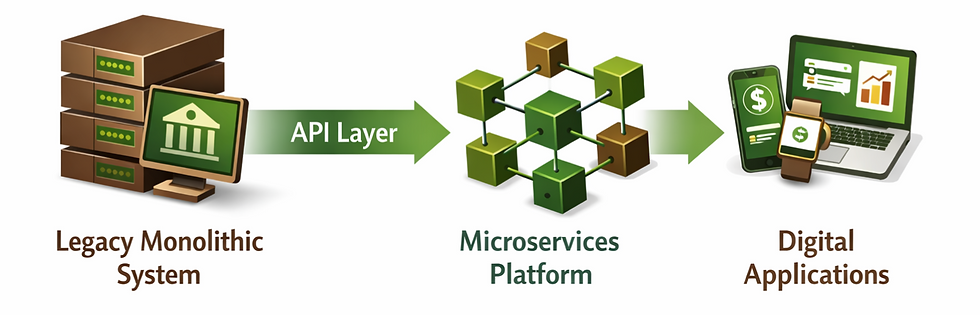
2. Define Modernization Strategies
Options include:
system replacement
platform consolidation
microservices architecture
API enablement
3. Implement Gradual Migration
Legacy transformation should occur through phased migration to minimize operational risk.
Tips
Prioritize modernization of high-cost legacy platforms
Use API layers to integrate legacy systems during transition
Pitfalls
• Attempting large-scale replacement without phased implementation
• Ignoring operational dependencies
Framework
Legacy Modernization Framework
legacy system identification
modernization strategy definition
phased transformation roadmap
migration implementation
Example in Practice
A European bank replaced its legacy payments system with a modern cloud-enabled platform.
The transformation achieved:
40% reduction in infrastructure costs
faster transaction processing
Suggested Template
Legacy Modernization Plan
SYSTEM | CURRENT COST | MODERNIZATION STRATEGY | EXPECTED SAVINGS |
|---|---|---|---|
Core Banking | €120M | Platform replacement | 30% |
Payments | €60M | API modernization | 25% |
KEY TAKEAWAYS |
|---|
|
Step 3: Deploy Robotic Process Automation (RPA)
Description
Robotic Process Automation (RPA) allows banks to automate repetitive operational tasks.
These tasks often include:
data entry
reconciliation processes
compliance reporting
account updates
Automation reduces both operational costs and human error.
Detailed Steps
1. Identify Automation Candidates
Best candidates include processes that are:
repetitive
rule-based
high-volume
Examples:
KYC verification
payment reconciliation
customer onboarding
2. Develop Automation Bots
RPA bots replicate human interactions with existing systems.
3. Integrate Automation with Workflow Systems
Automation should operate within broader digital workflow environments.

Tips
Focus on high-volume processes first
Combine automation with process simplification
Pitfalls
Automating inefficient processes
Lack of operational governance
Framework
Automation Opportunity Matrix
PROCESS | VOLUME | COMPLEXITY | AUTOMATION PRIORITY |
|---|---|---|---|
KYC Verification | High | Medium | High |
Loan Processing | Medium | High | Medium |
Example in Practice
A global bank automated its trade finance processing workflow using RPA.
Results included:
50% reduction in processing costs
improved processing accuracy
Suggested Template
Automation Opportunity Assessment
PROCESS | CURRENT COST | AUTOMATION POTENTIAL | EXPECTED SAVINGS |
|---|---|---|---|
KYC Processing | €30M | High | 45% |
Payment Reconciliation4 | €15M | Medium | 35% |
KEY TAKEAWAYS |
|---|
|
Step 4: Implement Cloud Infrastructure
Description
Cloud computing provides scalable infrastructure for modern banking operations.
Traditional banking infrastructure requires:
expensive hardware
complex maintenance
high capital expenditures
Cloud transformation converts infrastructure costs into flexible operational expenses.
Detailed Steps
1. Assess Cloud Migration Opportunities
Workloads suitable for cloud include:
digital banking platforms
analytics systems
development environments
2. Define Hybrid Cloud Architecture
Most banks adopt hybrid cloud models combining:
private cloud
public cloud
on-premise infrastructure
3. Migrate Workloads
Cloud migration must follow structured migration plans to avoid operational disruption.

Tips
Start with non-critical workloads
Develop cloud governance policies
Pitfalls
Poor cost management in cloud environments
insufficient cybersecurity controls
Framework
Cloud Transformation Framework
cloud readiness assessment
architecture design
migration planning
workload migration
Example in Practice
A global bank migrated its data analytics infrastructure to cloud platforms.
Benefits included:
35% infrastructure cost reduction
faster data processing
Suggested Template
Cloud Migration Plan
WORKLOAD | CURRENT INFRASTRUCTURE | TARGET CLOUD MODEL |
|---|---|---|
Data Analytics | On-premise servers | Public cloud |
Development | Local environments | Hybrid cloud |
KEY TAKEAWAYS |
|---|
|
Step 5: Optimize Data and Platform Integration
Description
Fragmented data systems significantly increase technology costs.
Banks often maintain:
multiple data warehouses
inconsistent data standards
disconnected analytics platforms
Optimizing data architecture reduces both technology complexity and operational costs.
Detailed Steps
1. Consolidate Data Platforms
Integrate:
customer data
transactional data
operational data
2. Standardize Data Governance
Define:
data ownership
data quality standards
access policies
3. Implement Data Integration Platforms
Use modern technologies such as:
data lakes
enterprise integration platforms

Tips
Develop enterprise-wide data architecture
prioritize integration of customer data
Pitfalls
Lack of data governance
incompatible data formats
Framework
Enterprise Data Architecture Model
data consolidation
integration platform
governance framework
analytics enablement
Example in Practice
A multinational bank integrated fragmented customer data systems into a unified data platform.
Results included:
20% reduction in technology costs
improved analytics capabilities
Suggested Template
Data Integration Roadmap
DATA SYSTEM | CURRENT STATE | TARGET INTEGRATION |
|---|---|---|
CRM Systems | Fragmented | Unified platform |
Transaction Data | Multiple databases | Enterprise data lake |
KEY TAKEAWAYS |
|---|
|
FINAL KEY TAKEAWAYS |
|---|
Automation and technology optimization allow banks to:
Successful transformation includes:
Banks that successfully implement these initiatives build modern, efficient, and scalable technology ecosystems. |


Comments