

Mastering Strategic Decisions With The Analytic Hierarchy Process (AHP): Mini Toolkits And Executive Templates For Practical AHP Implementation
For modern executives, frameworks only create impact when they translate into usable, repeatable tools.
The Analytic Hierarchy Process (AHP) offers immense potential for improving decision quality — but its long-term value lies in operationalizing it through practical templates, structured toolkits, and digital governance mechanisms.
This section serves as a comprehensive executive toolkit, consolidating the most effective AHP templates used across strategy, finance, procurement, and transformation programs.Each tool includes clear guidance, usage scenarios, and pro tips to help leadership teams apply AHP quickly and effectively.
Executive Decision Charter Template
Purpose: The Decision Charter defines the why, what, and who of a strategic decision before AHP modeling begins. It ensures all stakeholders share a unified understanding of scope and objectives.
When to Use: At the outset of any AHP project — whether it’s capital allocation, supplier evaluation, or strategic initiative prioritization.
Template: AHP Executive Decision Charter
SECTION | DESCRIPTION | EXAMPLE |
|---|---|---|
Strategic Goal | Define the precise decision to be made. | “Select the optimal global supplier for next-generation packaging.” |
Decision Horizon | Specify time frame of impact. | “Three-year procurement cycle.” |
Key Stakeholders | Identify the executives and departments involved. | CFO, COO, Chief Sustainability Officer. |
Success Criteria | Define how success will be measured. | “Cost reduction ≥10%, ESG compliance ≥90%.” |
Constraints | Note resource, regulatory, or timing limitations. | “Suppliers must meet EU sustainability guidelines.” |
Assumptions | Record baseline conditions. | “Demand forecast stable for next 12 months.” |
Pro Tip: Circulate the charter for sign-off before AHP analysis begins. Alignment here saves hours of downstream rework.
Criteria Hierarchy Builder
Purpose: To deconstruct complex strategic questions into manageable, logical layers — defining the AHP hierarchy of Goal → Criteria → Sub-Criteria → Alternatives.
When to Use: Immediately after the Decision Charter, to clarify decision logic and factor structure.
Template: Hierarchy Builder Worksheet
LEVEL | ELEMENT | EXAMPLE | RESPONSIBLE EXECUTIVE |
|---|---|---|---|
Goal | Ultimate decision objective | “Prioritize strategic investment portfolio.” | CEO |
Criteria | Key decision dimensions | Financial Return, Strategic Fit, Risk, Innovation | CFO, CSO |
Sub-Criteria | Supporting factors | ROI, IRR, Market Readiness, Execution Complexity | Strategy Office |
Alternatives | Options under evaluation | Project A, Project B, Project C | PMO |
Visualization Example:
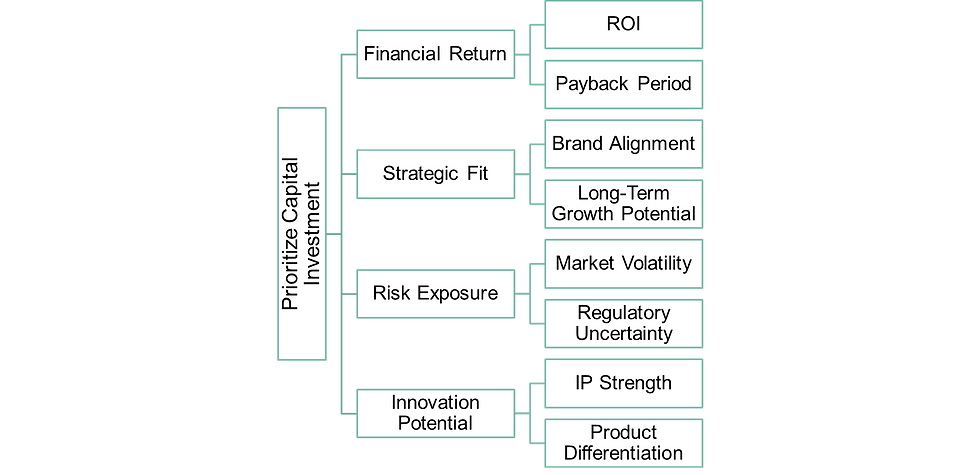
Pro Tip: Keep total criteria ≤ 7 and sub-criteria ≤ 5 for clarity and cognitive efficiency.
Pairwise Comparison Matrix Template
Purpose: To structure the process of pairwise comparisons — the analytical core of AHP where each criterion or alternative is evaluated against another.
When to Use: During the analysis phase when collecting judgments from executives and stakeholders.
Template: Pairwise Comparison Matrix
CRITERIA | COST | RELIABILITY | INNOVATION | ESG | STRATEGIC FIT |
|---|---|---|---|---|---|
Cost | 1 | 1/3 | 3 | 2 | 1/2 |
Reliability | 3 | 1 | 1/5 | 1/3 | 1/2 |
Innovation | 1/3 | 5 | 1 | 2 | 3 |
ESG | 1/2 | 3 | 1/2 | 1 | 2 |
Strategic Fit | 2 | 2 | 1/3 | 1/2 | 1 |
Scale Reference (Saaty’s 1–9 Importance Scale):
NUMERIC VALUE | INTERPRETATION |
|---|---|
1 | Equal importance |
3 | Moderate importance |
5 | Strong importance |
7 | Very strong importance |
9 | Extreme importance |
2,4,6,8 | Intermediate values |
Reciprocal (1/x) | If second element is more important |
Pro Tip: When using software (Expert Choice, TransparentChoice), this matrix is automated — but ensure executives understand what each scale value represents before entering judgments.
Consistency Validation Dashboard
Purpose: To verify the logical consistency of pairwise judgments and identify where recalibration is needed.
When to Use: After entering all comparisons to ensure decision reliability before synthesizing results.
Template: Consistency Validation Dashboard
CRITERIA | WEIGHT | CONSISTENCY INDEX (CI) | CONSISTENCY RATIO (CR) | STATUS |
|---|---|---|---|---|
Cost | 0.30 | 0.05 | 0.07 | Acceptable |
Reliability | 0.25 | 0.06 | 0.09 | Acceptable |
Innovation | 0.20 | 0.09 | 0.11 | Review |
ESG | 0.15 | 0.03 | 0.06 | Acceptable |
Strategic Fit | 0.10 | 0.07 | 0.10 | Acceptable |
Thresholds:
CR ≤ 0.10: Acceptable
CR 0.11–0.15: Needs review
CR > 0.15: Reassess criteria or judgments
Pro Tip: High CR doesn’t mean failure — it signals areas for executive dialogue and clarification.
Weighted Decision Dashboard
Purpose: To synthesize AHP outputs into a clear ranking of alternatives with visual clarity and executive readability.
When to Use: After calculations are complete — for executive presentation, board meetings, or investment committees.
Template: Weighted Decision Dashboard
CRITERIA | WEIGHT | ALTERNATIVE A | ALTERNATIVE B | ALTERNATIVE C |
|---|---|---|---|---|
Financial Return | 0.30 | 0.35 | 0.45 | 0.20 |
Strategic Fit | 0.25 | 0.40 | 0.30 | 0.30 |
Risk | 0.20 | 0.30 | 0.25 | 0.45 |
Innovation | 0.15 | 0.25 | 0.35 | 0.40 |
ESG | 0.10 | 0.20 | 0.40 | 0.30 |
Total Weighted Score | 1.00 | 0.32 | 0.37 | 0.31 |
Executive Interpretation:
Alternative B ranks highest, indicating optimal balance between risk, innovation, and return.
Alternatives A and C show potential under specific weighted scenarios.
Pro Tip: Visualize results using bar charts, radar graphs, or waterfall diagrams for rapid executive comprehension.
Sensitivity and Scenario Analysis Toolkit
Purpose: To test how sensitive AHP results are to changes in criteria weights — a vital tool for executives managing uncertainty or dynamic environments.
When to Use: Post-analysis, during strategic reviews or board meetings to validate decision robustness.
Template: Sensitivity Analysis Table
SCENARIO | ADJUSTED CRITERION | NEW WEIGHT | TOP-RANKED ALTERNATIVE | RANK STABILITY (%) |
|---|---|---|---|---|
Base Case | — | — | B | 100% |
ESG Priority | ESG ↑ to 0.20 | Innovation ↓ to 0.10 | B | 95% |
Risk-Averse | Risk ↑ to 0.30 | Financial Return ↓ to 0.25 | C | 80% |
Innovation-Led | Innovation ↑ to 0.25 | Risk ↓ to 0.15 | C | 85% |
Pro Tip: If rankings remain stable under multiple scenarios (stability > 80%), your decision is resilient.
Visualization Option: Use dynamic sliders in BI tools (Power BI, Tableau) to adjust weights live during executive discussions — a powerful way to build consensus.
Implementation Roadmap Template
Purpose: To translate AHP outcomes into actionable execution steps with accountability, timelines, and measurable outcomes.
When to Use: Immediately after AHP decision approval, during operational rollout planning.
Template: Decision Implementation Roadmap
PHASE | KEY ACTION | OWNER | TIMEFRAME | SUCCESS METRIC |
|---|---|---|---|---|
Validation | Present AHP results to executive committee | Chief Strategy Officer | Week 1 | Decision endorsement |
Communication | Share decision summary organization-wide | Communications Director | Week 2 | >90% stakeholder alignment |
Integration | Embed decision into ERP/PMO systems | COO / CIO | Month 1 | Execution started |
Monitoring | Track KPIs and validate assumptions quarterly | PMO | Ongoing | ROI > 12% |
Pro Tip: Integrate this roadmap directly into your project portfolio management tool to ensure traceability from decision to execution.
AHP Governance Framework
Purpose: To institutionalize decision-making standards, maintain methodological consistency, and ensure accountability.
When to Use: Once the organization begins adopting AHP across multiple functions (procurement, capital planning, transformation).
Template: Governance Framework
GOVERNANCE LAYER | RESPONSIBILITY | DELIVERABLES |
|---|---|---|
Executive Committee | Define strategic priorities; approve final AHP decisions | Decision mandates; board reports |
Strategy Office / Decision CoE | Maintain methodology, train users, review models | Templates, playbooks, audit reports |
Functional Leaders | Provide domain inputs and pairwise judgments | Criteria and sub-criteria evaluations |
Analytics / IT Team | Manage AHP tools and integrations | Dashboards, CR monitoring, data linkage |
Internal Audit / Risk | Validate compliance and decision traceability | Review logs and consistency reports |
Pro Tip: Document every major decision with its AHP model summary for internal audit — this strengthens governance credibility.
AHP ROI and Performance Tracking Dashboard
Purpose: To measure how AHP improves decision quality, speed, and transparency over time — essential for executive sponsorship and budget justification.
When to Use: Quarterly or annually as part of strategic planning and governance reviews.
Template: AHP ROI Dashboard
KPI CATEGORY | INDICATOR | TARGET | ACTUAL | STATUS |
|---|---|---|---|---|
Decision Quality | % of major decisions supported by AHP | 80% | 72% | In Progress |
Decision Speed | Average decision cycle time (days) | 10 | 7 | Improved |
Consistency | % of models with CR < 0.10 | 95% | 92% | Review |
Stakeholder Confidence | Satisfaction with decision transparency | 85% | 88% | Exceeded |
Financial Outcome | ROI improvement from AHP-backed initiatives | +10% | +14% | Achieved |
Pro Tip: Include qualitative success metrics — such as “executive alignment achieved” — to capture intangible AHP benefits like trust and collaboration.
AHP Digital Integration Blueprint
Purpose: To ensure AHP models connect seamlessly with enterprise data and analytics platforms.
When to Use: During the scaling phase, when embedding AHP into broader business systems (ERP, BI, PMO).
Template: AHP Integration Blueprint
SYSTEM | INTEGRATION PURPOSE | EXAMPLE |
|---|---|---|
ERP (SAP, Oracle) | Link cost, ROI, and performance data | Automatic update of financial criteria |
BI (Power BI, Tableau) | Visualize AHP outcomes in real time | Live dashboards for board meetings |
CRM (Salesforce) | Align customer segmentation and project prioritization | Market potential analysis |
Project Management (Asana, Jira) | Connect decision priorities to execution | Direct import of approved initiatives |
AI & Predictive Tools | Support data-driven weighting and sensitivity | AI-suggested weight updates |
Pro Tip: Start with BI integration — it delivers visible impact fastest and requires minimal structural change.
Executive AHP Playbook Summary
This final toolkit summarizes the entire AHP workflow — an at-a-glance reference for executive teams and strategy offices.
AHP Executive Workflow Map
PHASE | OBJECTIVE | KEY DELIVERABLE | TOOLKIT / TEMPLATE |
|---|---|---|---|
1. Define | Clarify decision purpose | Decision Charter | Template #1 |
2. Structure | Develop hierarchy and criteria | Hierarchy Builder | Template #2 |
3. Compare | Conduct pairwise evaluations | Comparison Matrix | Template #3 |
4. Validate | Ensure logical consistency | Validation Dashboard | Template #4 |
5. Synthesize | Rank and visualize outcomes | Weighted Dashboard | Template #5 |
6. Test Scenarios | Assess decision robustness | Sensitivity Toolkit | Template #6 |
7. Execute | Convert decision into action | Implementation Roadmap | Template #7 |
8. Govern | Maintain consistency enterprise-wide | Governance Framework | Template #8 |
9. Measure | Track performance and ROI | ROI Dashboard | Template #9 |
10. Integrate | Connect AHP to enterprise systems | Integration Blueprint | Template #10 |
Pro Tip for Strategy Leaders:
Package these templates into a centralized AHP Playbook Portal — a shared digital workspace (e.g., SharePoint, Notion, or Confluence).Include:
Pre-filled examples from successful decisions.
Video walkthroughs for new users.
Links to BI dashboards for real-time analytics.
This approach transforms AHP from a method into a living management system.
Building an Internal AHP Center of Excellence (CoE)
For large organizations, scaling AHP requires a dedicated capability hub that ensures consistency, quality, and innovation in decision science.
CoE Responsibilities
Methodology Stewardship: Maintain AHP templates, criteria libraries, and training materials.
Capability Development: Run executive workshops and analyst certification programs.
Technology Management: Oversee AHP software, integration, and updates.
Quality Control: Review CR ratios, validate models, and track outcomes.
Knowledge Sharing: Archive case studies and success stories for internal learning.
Pro Tip: Position the CoE under the Strategy or Transformation Office to ensure alignment with enterprise priorities.
Mini Toolkit: CoE Implementation Plan
PHASE | ACTIVITY | DELIVERABLE |
|---|---|---|
Phase 1: Setup | Identify sponsors, define scope | CoE Charter |
Phase 2: Development | Build template repository and governance policy | AHP Playbook |
Phase 3: Training | Conduct workshops for leaders and analysts | Training Modules |
Phase 4: Scale | Integrate AHP into enterprise workflows | Enterprise Decision Portal |
Phase 5: Review | Measure adoption and ROI | Quarterly AHP Maturity Report |
Executive Reflection: Turning Tools into Transformation
These toolkits are not merely templates — they are decision enablers.When executives and teams use them consistently, they transform AHP from a technical exercise into an organizational discipline of analytical leadership.
Each toolkit builds upon the last:
The Decision Charter ensures purpose.
The Hierarchy Builder ensures logic.
The Comparison Matrix ensures transparency.
The Governance Framework ensures continuity.
Collectively, they create a strategic rhythm of decision intelligence — a system where every major corporate decision is data-informed, documented, and directionally aligned with organizational strategy.
TAKEAWAY |
|---|
|

Comments